
I found a copy of Creative Review’s AI issue from 2017 this weekend.
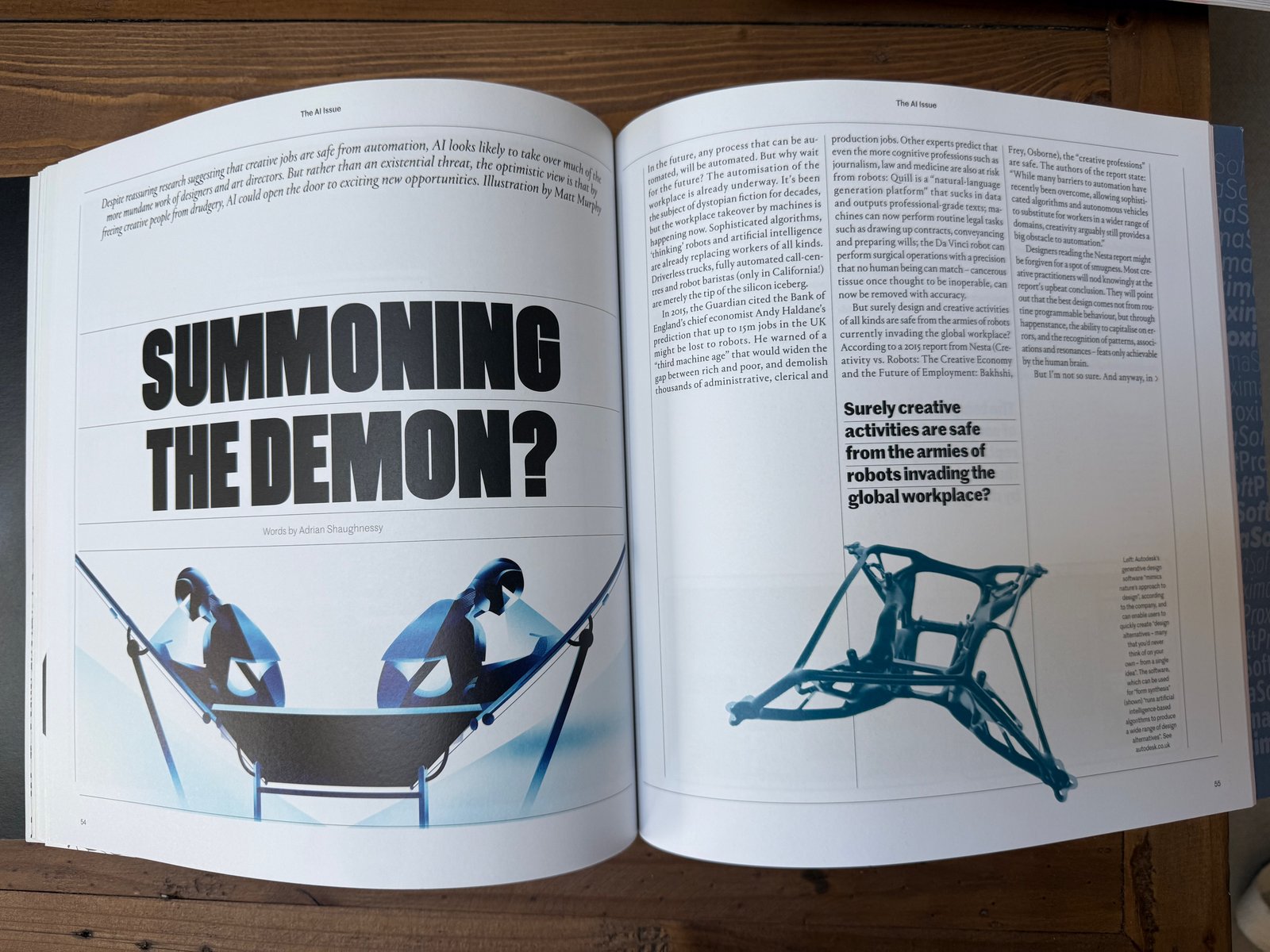
One sentence jumped out.
“AI looks likely to take over much of the more mundane work of designers and art directors.”Adrian Shaughnessy, Creative Review, 2017
That was the fairly sensible assumption at the time.
AI would do the boring stuff. Humans would keep the creative stuff.
Nearly ten years later, I’m not sure it played out like that at all.
AI turned out to be surprisingly good at the supposedly human bit. Writing. Images. Ideas. Code. Music. Video.
The mundane work was never actually mundane
Go back to the kind of work the magazine had in mind — drawing up contracts, scheduling, filing, chasing invoices — and look at it properly. None of it is mundane. It’s familiar. Those aren’t the same thing.
An invoice looks mundane until the customer has queried three of the last five, and someone has to decide whether this one is another try-on or a genuine mistake. A contract clause looks mundane until you’re the person judging whether the client will accept the amended wording or walk. A scheduling change looks mundane until it means telling a long-standing customer they’re being bumped for someone bigger.
What made this work look automatable was that it was repetitive on the surface. What actually made it hard was the judgement sitting underneath the repetition — judgement built from knowing this customer, this supplier, this particular way the business has been burned before. A magazine in 2017 could see the repetition. It had no way of seeing the judgement, because most of it was never written down anywhere.
A draft is not a finished business task
The other half of the surprise is what AI turned out to be good at. Ask it for a first draft of a contract clause, a difficult email, a set of design options, a piece of code, and it will usually hand you something usable in seconds. That was the bit that felt safely human in 2017. It’s the bit that’s fallen fastest.
But producing a draft and finishing a business task are two different jobs, and the gap between them is where most AI work actually lives now. A drafted email still has to go to the right person, in the right tone, referencing the real account history, without promising something the business can’t deliver. A drafted contract clause still has to be checked against the specific deal, and someone still has to be willing to put their name to it. AI gets you most of the way there in a way nobody would have predicted a decade ago. It very rarely gets you all the way — and the last part, where somebody is accountable if it’s wrong, hasn’t moved nearly as much as the drafting has.
It’s not really a mystery, in hindsight. Writing, images, code and music are exactly the kind of thing a model trained on enormous amounts of existing writing, images, code and music turns out to be good at. There’s a vast public record of how humans do that work, freely available to learn from.
There’s no equivalent record of how your business actually runs. Nobody publishes the exceptions your team quietly handles every Friday, the reason one particular customer always gets a different answer, or which of the “straightforward” approvals is never actually straightforward. That knowledge lives in people’s heads and in the gaps between systems — exactly the kind of thing a general-purpose model has never seen and can’t simply absorb from the internet.
Meanwhile some of the boring stuff has proved remarkably difficult.
Not because AI can’t do it. Because real businesses are messy.
Permissions. Exceptions. Bad data. Legacy systems. Customers doing unexpected things. Decisions where somebody ultimately has to be responsible.
It’s something we’re seeing repeatedly in our work at Woodlark. Getting AI to produce something impressive is relatively easy. Making it reliably useful inside a business is much harder.
Where owners can sensibly start
None of this is an argument for waiting. It’s an argument for starting in the right place.
The businesses getting real value from AI right now aren’t the ones chasing the most impressive demo. They’re the ones picking one narrow, well-bounded piece of the “boring” work — a specific report, a specific type of customer query, a specific first draft — and giving AI a small, closely-watched amount of it to begin with. Someone checks the output before it goes anywhere near a customer or a ledger. The system earns more scope only once the evidence says it’s reliable, not because the demo looked good in a meeting.
That’s a slower story than the one the industry likes to tell. It’s also the one that survives contact with a messy business — the exceptions, the legacy system nobody wants to touch, the one big customer who does everything differently. Start there, in the open, and progress compounds. Start with the ambition and skip the boring supervision, and you find out the hard way exactly what the magazine underestimated.
Which makes me wonder whether we had the automation question slightly backwards.
The creative work wasn’t necessarily the hard bit to automate. The organisation was.
So if you’re wondering where to start: not with the impressive bit. Start with the boring bit nobody’s written down — and watch closely while AI does it.
Sources
- Creative Review: “Summoning the Demon?” by Adrian Shaughnessy, The AI Issue, 2017 (print edition)