
AI has had an odd week
I spent 20 years in media, so I still watch news cycles more closely than is probably healthy. I am interested in the facts, but also in the way a story moves: what becomes the headline, what disappears underneath it and what the next day’s coverage does to the story we thought we understood.
AI has produced a particularly sharp version of that over the past week. One set of headlines asked whether it could eventually pose an existential threat. Another reported that AI might already be helping the British economy grow.
The economic story caught my attention because it raised a more practical question. If AI is starting to register in national growth figures, what is actually happening inside the businesses using it?
Growth has an AI signal
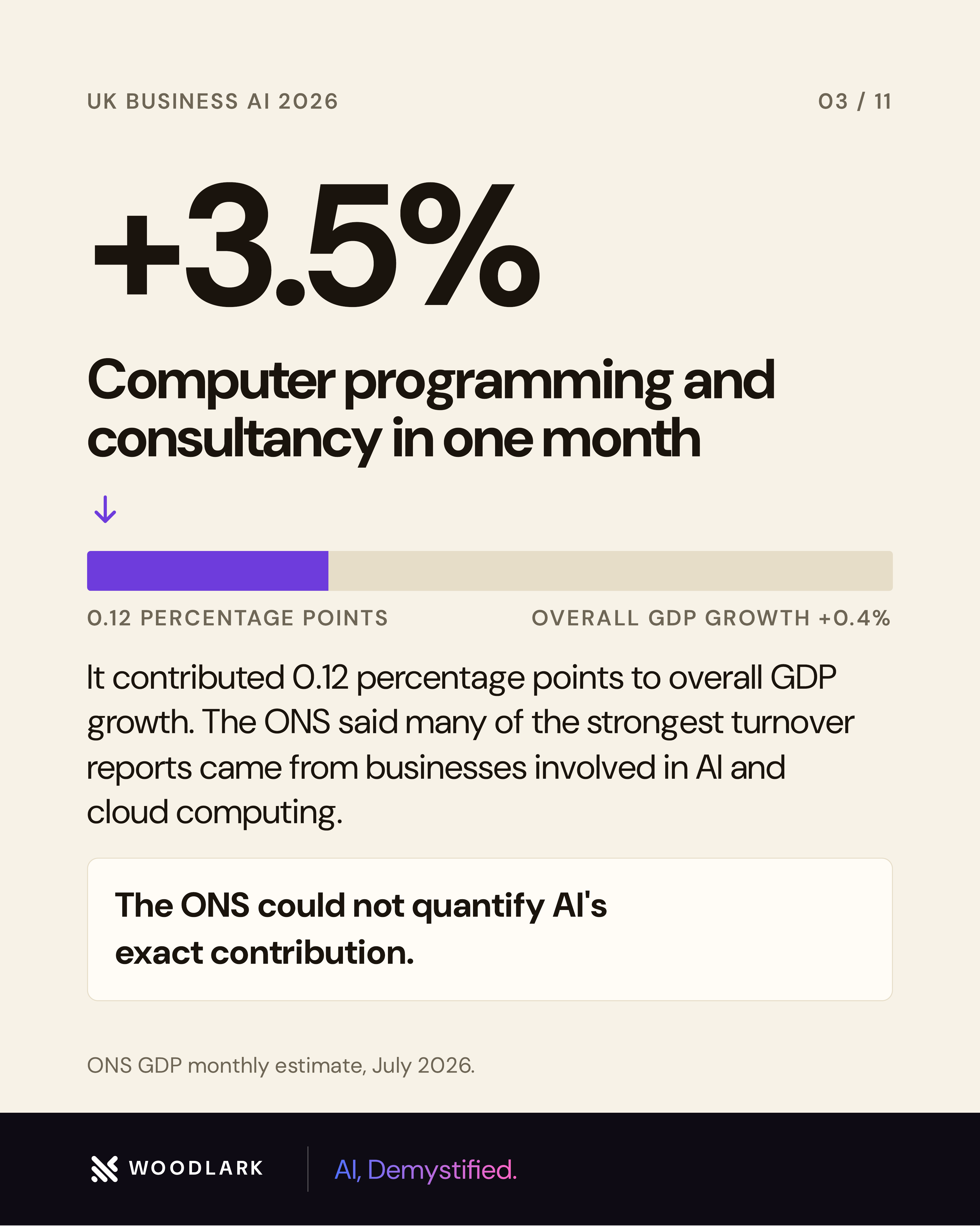
On 11 September, the Office for National Statistics reported that UK GDP grew by 0.4% in July 2026. Reuters said economists in its poll had expected no growth. The economy was 1.6% larger than a year earlier, its fastest annual pace for 18 months.
The most interesting detail sat inside the services numbers. Computer programming, consultancy and related activities grew by 3.5% in July and contributed 0.12 percentage points to overall GDP growth. The ONS said many of the businesses reporting the largest turnover increases in computer programming and information services were involved in AI and cloud computing.
That does not mean AI caused all, or even most, of July’s growth. The ONS is careful on this point: its data cannot quantify the exact contribution made by AI and cloud activity. The responsible conclusion is that there is a visible AI signal in a part of the economy that made a material contribution to the month’s growth. The press headline was a possible AI boost, not a settled measure of an AI dividend.
Adoption has almost tripled
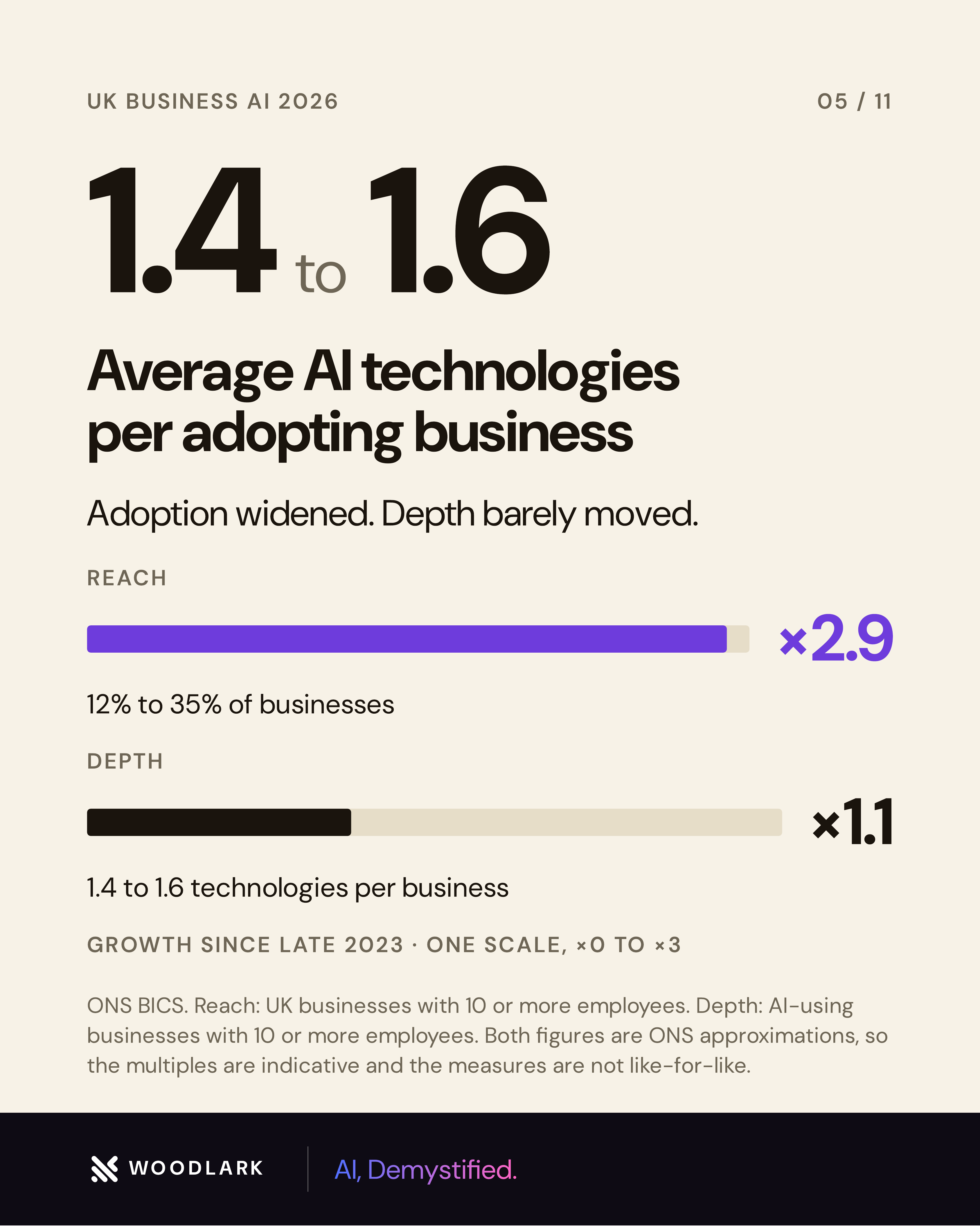
A separate ONS study published in July gives a much clearer view of business adoption. Among UK businesses with 10 or more employees, the proportion reporting use of at least one AI technology rose from around 12% in late 2023 to around 35% in June 2026. That is just under three times the starting level.
The variation between sectors is large. Fifty-eight per cent of information and communication businesses reported using AI, compared with 13% in construction. Company size matters too: 28% of businesses with fewer than 10 employees reported AI use, rising to 49% among businesses with 250 or more employees.
Large language models were the most commonly reported technology among businesses with 10 or more employees, at 18%. Visual content creation followed at 16%, then machine-learning data processing at 12% and image processing at 6%. Robotics sat at 2%.
So the adoption story is real. More firms are using AI, and the growth has been quick. The next part of the ONS report is more revealing.
Depth has barely moved
Among businesses already using AI, the average number of AI technologies in use has risen from about 1.4 in 2023 to 1.6 in 2026. The ONS describes the change as modest and says it implies relatively limited transformative impact so far for most adopting firms.
Only 10% of AI-using businesses with 10 or more employees say they use it extensively. Only 15% say more than half of their employees use AI as part of their daily work. Those questions are new, so the ONS treats the results as early indications. Even with that qualification, the pattern is hard to miss.
The adoption number tells us that AI has entered the business. It does not tell us whether a workflow has changed, whether decisions are faster, whether errors have fallen or whether the system survives contact with a busy Tuesday morning.
Employees may be ahead of their employers
The report contains another striking comparison. In a separate ONS survey, 55% of employed and self-employed people said they used AI for work or education. The business measure was 35%.
The two figures are not directly like-for-like. The employee measure covers Great Britain and includes education, while the business figure covers UK firms with 10 or more employees and asks about specific AI technologies. The ONS makes that clear.
Even so, it offers a plausible picture of how adoption is happening. Individuals are trying AI for a draft, a summary, a spreadsheet or a presentation, sometimes before the organisation has made a formal decision about the tool, the data or the process. The experimentation sits with the person. The operating model has not caught up.
Most businesses are improving what already exists
Around three-fifths of businesses using AI say they use it to improve existing operations. It is the most common purpose across every company size. Fewer businesses report using AI to develop new products or services or to explore new markets.
That is not a criticism. Existing operations are often exactly where the first useful result sits: a hand-off that takes two days, a report rebuilt every Monday, a customer request copied between systems or a decision held up because the information is scattered.
But it explains why a rapid rise in adoption can coexist with limited transformation. A business can buy access to an AI tool without changing a process. It can run a pilot without giving the system an owner. It can let a team experiment without agreeing what happens when the answer is wrong. All of those count as use. None guarantees a lasting operational result.
The jobs story is quieter than the headlines
The labour-market findings are also more measured than much of the public debate. Most businesses adopting AI reported no change to overall headcount. Among businesses using AI to improve operations, 63% reported no change, 6% reported a decrease and 1% reported an increase. A sizeable group was still unsure or considered the question not applicable across the wider set of AI-using businesses.
That does not mean work is standing still. The ONS found that the roles affected depend on the technology. Visual-content tools were most often associated with changes to creative or design roles. Machine-learning data processing was most commonly associated with administrative, clerical and data-analysis work.
For now, the clearer signal is a change in tasks and responsibilities rather than a wholesale change in workforce size. That is exactly why implementation is a management issue as much as a technical one. Someone has to decide which work moves, what stays with a person and who remains accountable for the result.
The gap is capability
Access to AI is no longer the whole problem. Forty-one per cent of businesses with 10 or more employees said they had experienced no barrier to adoption in the previous three months. Among those reporting barriers, expertise and cost featured prominently.
Training is the most common response. Sixty-two per cent of businesses citing a lack of AI expertise said they were training or retraining existing staff. Yet only 11% of businesses with 10 or more employees said more than half of their workforce had received AI-related training.
That combination matters. Tools are widely available, informal use is spreading and the formal adoption figure is climbing. The thinner layer is organisational capability: choosing the right work, redesigning it properly, setting controls, teaching people how to run the new process and measuring whether it has improved anything.
What depth looks like
Deeper adoption does not mean adding AI to every corner of a company. It means choosing work where the value and the risk can both be seen.
- A real workflow, with a starting point and an observable result.
- A named owner who remains responsible for the outcome.
- Clear approval points for decisions that cost money, affect a customer or are hard to reverse.
- An audit trail that shows what the system did and why.
- Training and a regular operating rhythm so the process still works in month three.
A browser tab can save an individual some time. A redesigned workflow can change the way a business operates. The ONS numbers suggest the first is spreading much faster than the second.
The economy may already be catching the first signal from AI and cloud activity. Inside most businesses, the larger operational shift is still at an early stage. That is where the opportunity now sits.
The useful question is no longer whether a business uses AI. It is what the business can now do differently because AI exists.
Sources
- Office for National Statistics: Artificial intelligence in UK businesses, 2023 to 2026
- Office for National Statistics: GDP monthly estimate, UK: July 2026
- Reuters: “UK economy grows by most since early 2025 on possible AI boost” (11 September 2026)
The ONS business survey excludes some industries and describes several of its newest measures as early indications. Unless otherwise stated, the headline business figures refer to organisations with 10 or more employees.